
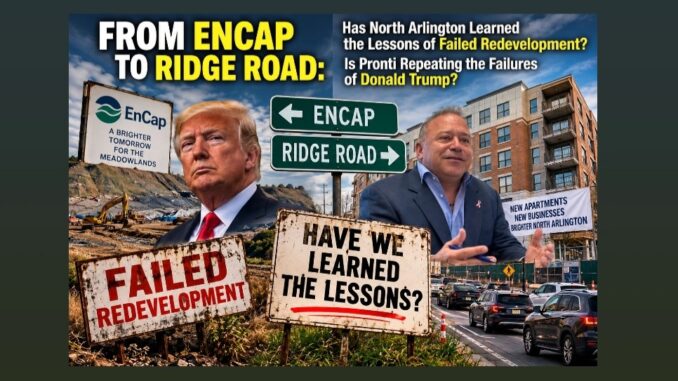
FROM ENCAP TO RIDGE ROAD:
Has North Arlington Learned the Lessons of Failed Redevelopment?
Is Pronti repeating the failures of Donald Trump?
NORTH ARLINGTON – There are several potentially meaningful parallels between the failed EnCap redevelopment project in North Arlington and the current redevelopment agenda under Republican Mayor Dan Pronti.
The central question is whether both periods reflect a similar approach to economic development: large-scale redevelopment promoted as progress, with residents left to weigh the promised benefits against the costs, risks, and long-term effects on the borough.
The EnCap controversy provides a historical benchmark. What was promised, who supported it, what risks were identified, and what ultimately happened?
Those are the same questions residents can ask about today’s apartment explosion, redevelopment agreements, tax implications, infrastructure demands, and neighborhood impacts.
Five important parallels:
1. The promise of redevelopment as “progress.”
EnCap proposed a major transformation of former Meadowlands landfill sites, combining remediation with housing, golf courses, hotels and other development. The project was promoted as an opportunity to transform underused land. Pronti’s administration, meanwhile, describes redevelopment along Ridge Road as part of North Arlington’s renaissance, with new housing and businesses.
Nothing could be further from the truth. In both cases, redevelopment is presented as a way to modernize the borough. The key question is how the promised benefits compare with the costs borne by residents.
2. Political backing for ambitious private development
Donald Trump announced a plan in November 2007 to rescue EnCap with a golf course, homes and a hotel. The project nevertheless collapsed, and the Meadowlands Commission terminated its agreement with EnCap in May 2008.
Today’s comparison concerns the political support given to developers and redevelopment plans under Pronti. North Arlington’s official records and redevelopment ordinances can establish which proposals he and the council supported.
The answer is all of them!
The parallel: In each era, residents have reason to scrutinize the relationship between ambitious development proposals and the elected officials advancing them.
77 Ridge Rd, North Arlington, NJ 07031 | LoopNet
3. The tension between development and neighborhood character:
EnCap envisioned approximately 1,500 housing units in the broader proposal described in local reporting, including development that would have affected North Arlington’s Porete Avenue business district.
Current redevelopment has a different footprint, including apartment construction along Ridge Road.
The parallel: Both raise questions about density, traffic, parking, local businesses and whether the scale of development fits the community.
The important distinction is that EnCap was a large, multi-municipality landfill redevelopment proposal; Ridge Road apartment projects are separate developments under local redevelopment plans.
4. The need to scrutinize financial risk:
The New Jersey Office of the Inspector General’s 2008 EnCap investigation examined public financing, project management, cost overruns and risks to municipalities. Its report documented substantial public financing arrangements and concerns about the project’s financial structure.
Current redevelopment should be assessed using its own financial records: tax abatements, payments in lieu of taxes (PILOTs), infrastructure costs, municipal service demands and projected property-tax revenues.
Residents need to know not simply how much private investment is promised, but how much public assistance is committed and what taxpayers receive in return.
5. The importance of public accountability: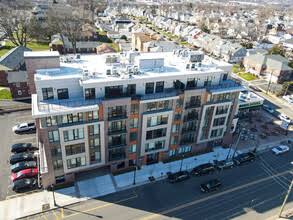
EnCap ultimately failed, and the borough’s 2016 Master Plan Reexamination Report says the former assumptions about development of Meadowlands land had changed substantially. The report describes the subsequent Kingsland Area Redevelopment Plan as the replacement framework.
For current projects, the accountability test is whether the borough publishes clear projections, explains its approvals and evaluates the cumulative effects of multiple developments.
The parallel is that proposal’s initial promise is not the same as a demonstrated public benefit!
What the historical record says about Republicans and EnCap:
Local reporting identifies Republican councilman and then redevelopment official Kirk Del Russo as a supporter of EnCap. It also describes Donald Trump’s involvement in an attempted rescue of the project.
No Republican ever went on the record opposing EnCap, the same way no current Republican opposes the massive overdevelopment of Ridge Road in the hundreds of units!
North Arlington’s 2014 council minutes provide useful context: they describe the borough’s earlier efforts to move beyond EnCap and pursue alternative redevelopment strategies. The minutes also record support for revising redevelopment plans to accommodate prospective developers.
Pronti’s presents redevelopment as a central accomplishment. The borough’s own mayoral biography describes revitalization of outdated and vacant areas and the attraction of new businesses and developers.
Is North Arlington repeating the same mistake under Pronti it did with then developer Donald Trump?
The strongest historical comparison is not that EnCap and today’s apartment projects are identical. It is that North Arlington has already experienced the risks of putting ambitious redevelopment promises ahead of rigorous scrutiny of financial exposure, environmental constraints and neighborhood opposition.
The EnCap failure makes those questions particularly relevant today.
Pronti’s record represents a continuation of the same failed policy approach, far beyond party affiliation alone! His current redevelopment consultant Robert Ceberio was a proponent of the EnCap proposal!
Yes, Robert Ceberio was a supporter and key defender of the EnCap project
during his tenure with the New Jersey Meadowlands Commission (formerly the Hackensack Meadowlands Development Commission).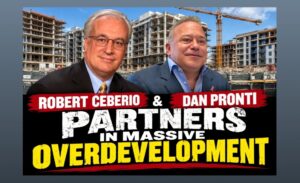
Ceberio is a campaign donor and confidante to the Pronti political machine!
As the executive director of the commission, he placed significant faith in the ill-fated development plan—which aimed to convert former landfills into a massive complex of luxury shopping, homes, and golf courses. Ceberio later noted that the commission was not alone in its backing, pointing out that the controversial project was actively endorsed by multiple New Jersey governors and heavily negotiated alongside the state Attorney General’s Office before it ultimately unraveled financially.
- Is a failed history repeating itself?
- Issue
- EnCap-era question
- Question for Pronti’s administration
- Public cost
- What financial commitments and risks did the project create?
- What abatements, infrastructure expenses and municipal obligations accompany current projects?
- Housing
- What housing was proposed, and at what scale?
- How many units have been approved or built, and how do they affect population and service demand?
- Neighborhood impact
- What would have happened to Porete Avenue businesses?
- What are the documented effects on Ridge Road parking, traffic and existing businesses?
- Accountability
- Why did the original development arrangement fail?
- What safeguards, deadlines and performance requirements protect the borough today?
- Public benefit
What did residents ultimately gain from the failed proposal?
What measurable net revenue, employment and service improvements are current projects delivering?
The definition of stupidity is doing the same thing over and over again and expecting different results.
Don’t compound the same mistake a third time!
We need a new Mayor.
John Balwierczak, keeping NA small, safe, suburban and affordable.
Balwierczak can be reached at (201) 655-8497 or via e-mail at [email protected]
Join the campaign!
Volunteer, place a sign or donate financially!